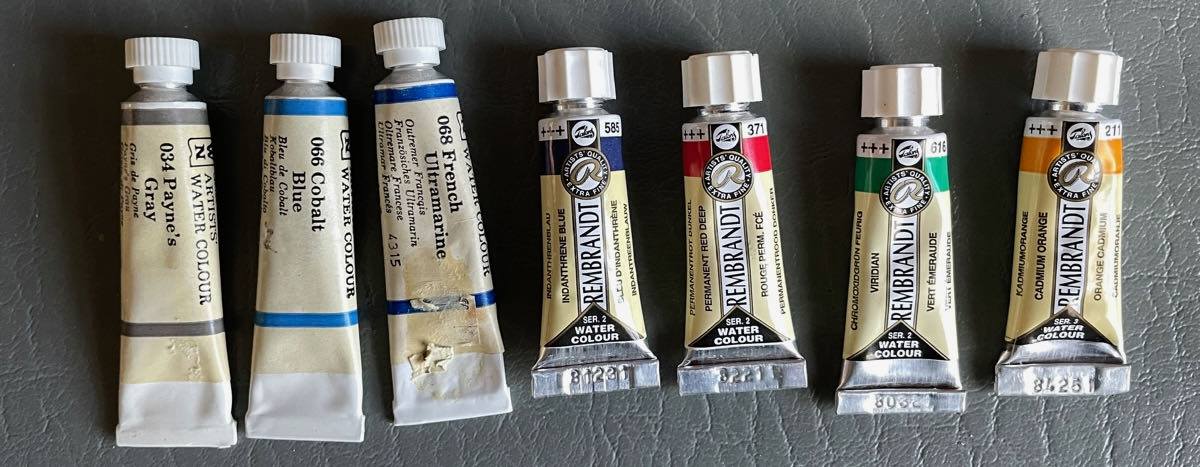
Revised & Improved Core Passage
Although it is possible to achieve a broad and useful range of hues by mixing black, white, and the three primary colors—red, yellow, and blue—the physical nature of pigments places real limits on such mixtures. Each pigment has its own opacity, tinting strength, temperature, and undertone, and because of these inherent differences, certain color effects can be achieved only through the use of additional pigments.
That said, strong tonal harmony and a coherent color key can often be achieved by working with a deliberately limited palette. By selecting a small, well-chosen range of colors—typically one red, one blue, and one yellow, along with white and possibly black—the painter encourages unity throughout the painting. The specific choice of pigments within each primary family should be guided by the desired tonal range, temperature balance, and overall mood of the work.
Advantages of a Limited Palette
For Beginners
A limited palette offers significant educational benefits for painters at the early stages of learning:
1. Faster Understanding of Color Relationships
Using fewer pigments forces the painter to mix colors intentionally rather than rely on pre-made hues. This accelerates understanding of hue, value, temperature, and chroma.
2. Improved Color Harmony
Because all mixtures originate from the same small group of pigments, the resulting colors naturally relate to one another. This prevents the common beginner mistake of disjointed or overly saturated color passages.
3. Better Control of Value
Beginners often struggle more with value than color. A limited palette simplifies the process, making it easier to focus on light and dark relationships rather than chasing exact hues.
4. Reduced Muddy Color Mixing
Fewer pigments in each mixture reduce the likelihood of accidental over-mixing, which often results in dull or muddy colors.
5. Stronger Observation Skills
With fewer colors available, beginners must rely more on observation and judgment, learning how subtle shifts in value or temperature can describe form and light effectively.
For Advanced Painters
For experienced artists, a limited palette is not a restriction but a powerful design tool:
1. Unified Tonal Key
Advanced painters use limited palettes to maintain a consistent color key throughout the painting, reinforcing mood, atmosphere, and narrative coherence.
2. Greater Color Subtlety
Rather than producing a wide range of bright hues, a limited palette encourages nuanced color variation—small temperature shifts that create sophistication and depth.
3. Increased Speed and Efficiency
Fewer pigments on the palette reduce decision fatigue and streamline the painting process, allowing the artist to work more fluidly and intuitively.
4. Stronger Atmospheric Effects
Landscapes, portraits, and interiors often benefit from restrained color schemes that support realistic light conditions, aerial perspective, and natural transitions.
5. Historical and Archival Precedent
Many Old Master painters worked with remarkably limited palettes, relying on value, glazing, and layering rather than a broad selection of pigments. This approach has proven both durable and visually powerful over centuries.
Choosing the Right Limited Palette
A limited palette does not mean a fixed palette. Different paintings may require different pigment selections. For example:
A warm-toned portrait may favor a warm red, yellow, and a muted blue
A cool landscape may benefit from a cooler blue and yellow
A high-key painting may require pigments with greater transparency and tinting strength
The key is not the number of pigments used, but how thoughtfully they are chosen and harmonized.
Frequently Asked Questions
What is a limited palette in painting?
A limited palette is a deliberate restriction of the number of pigments used in a painting, typically one red, one yellow, one blue, plus white and sometimes black. All colors in the painting are mixed from this small selection.
Why do artists use a limited palette?
Artists use a limited palette to create stronger color harmony, improve control over value and temperature, and maintain a unified tonal key throughout the painting.
Is a limited palette only for beginners?
No. While a limited palette is an excellent learning tool for beginners, advanced painters also use it intentionally as a design strategy to control mood, atmosphere, and color relationships.
How does a limited palette help beginners learn faster?
By reducing the number of pigments, beginners are forced to mix colors thoughtfully, improving their understanding of hue, value, temperature, and chroma while avoiding confusion and muddy mixtures.
Does a limited palette restrict the range of colors?
While it limits the number of pigments, it does not necessarily limit expressive range. Skilled mixing can produce a wide variety of nuanced colors that feel more unified than mixtures from a large palette.
Why do limited palettes often look more harmonious?
Because all colors share common pigment origins, they naturally relate to one another, preventing abrupt or discordant color contrasts.
Can all colors be mixed from red, yellow, and blue?
Although many useful colors can be mixed from the primaries, some specific hues are difficult or impossible to achieve due to pigment undertones, opacity, and tinting strength. These limitations are part of the artistic decision-making process.
How should pigments be chosen for a limited palette?
Pigments should be selected based on temperature, transparency, and the desired tonal harmony of the painting. Different subjects may require warmer or cooler versions of each primary color.
What role does value play in a limited palette?
Value relationships are often more important than exact color matches. A limited palette simplifies value control, helping the painter focus on light and form rather than chasing precise hues.
Do limited palettes reduce muddy color mixing?
Yes. Using fewer pigments in each mixture reduces the chance of over-mixing complementary colors, which often causes dull or muddy results.
Did historical painters use limited palettes?
Yes. Many Old Master painters worked with surprisingly few pigments, relying on layering, glazing, and value control rather than a large selection of colors.
Should black be included in a limited palette?
Black is optional. Some painters prefer mixing darks from their primaries to maintain color richness, while others include black for structural or stylistic reasons.
Can a limited palette be changed from painting to painting?
Absolutely. A limited palette should be adapted to the subject, lighting conditions, and emotional tone of each painting rather than treated as a fixed formula.
Is a limited palette suitable for all painting styles?
A limited palette works especially well for portraits, landscapes, and tonal painting. Highly decorative or high-chroma styles may require additional pigments.